|
Electric Circuits are Closed Circulating Loops |
|
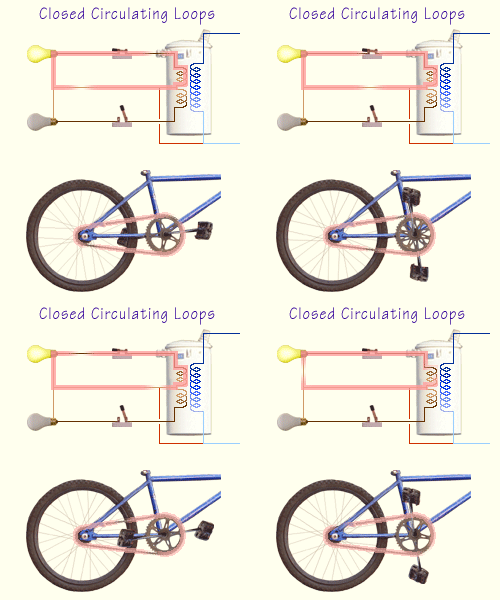
Electric circuits work much like bicycle chains transferring power from the
pedals (front sprocket) to the back wheel (rear sprocket). If the chain does not travel
in a loop, power cannot be transferred to the wheel. Similarly, closed loop
circuits move electric energy. Current forced by a source (generator or transformer)
travels around a closed supply circuit; it goes through the electrical appliance
to perform the desired function, and then returns to the source. If the circuit
is broken at any point, the current circulation stops and the electric
energy flow also ends. This is how a light switch turns a light
on and off.
|
 |
|
|
|
The return portion of the loop (the white wire in residential circuits)
is not always obvious. In motor vehicles, for example, the return circuit
is the body of the car itself, which is invariably metallic. This would be
equivalent to power utilities utilizing the earth as a return path for current.
While such systems do exist, they are rare and not used for standard power
applications in the United States. |
|
Grounding is done principally to ensure
electric safety, but results in currents in the earth.
Using the earth intentionally as a
current conductor is different than having earth currents as a side effect, which is
harmless. The decision in favor of electrical
safety at the expense of some earth current byproduct has been made
unanimously around the United States and most other
countries around the world.
|
|
|
