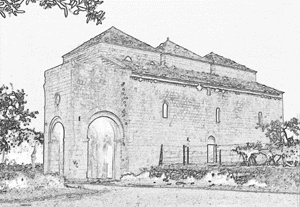
Location. Allsaints Church rises in the fields surrounding Valenzano, less than a mile from the edge of town, on the road to Capurso. The church, part of the Archdioceses of Bari, is what remains of a monastery complex of the XI century.
|
The Benedictines Erected the Abbey in 1078. The Allsaints Abbey was erected at Cuti (an ancient name for this area near Valenzano) between 1061 and 1078 by the abbott Eustasio that together with a following of Benedictine monks cleared and cultivated the sterile land that surrounds the monastery. Eustasio managed well, ensuring that the Abbey was provided with the material goods necessary to sustain the Benedictine community: olive orchards, wine groves, and vegetables gardens.
|
|
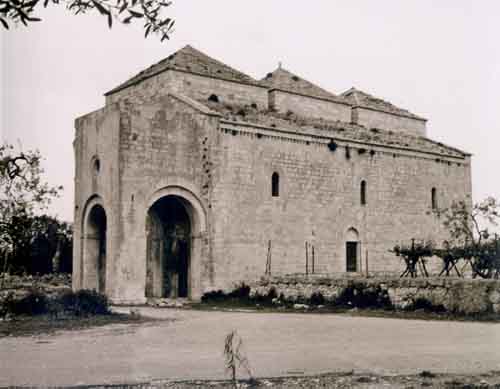
Allsaints Church is what is left of the Abbey.
|
The Abbey Became an Economic Success. Eustasio called upon the local farmers to cultivate the land owned by the Abbey, using lease contracts to tie the populace to the monastic institute. The amount of property owned by the Abbey grew in time, principally due to a number of donations, making the Abbey an economic powerhouse. For example, in 1124, Grimoaldo Alfaranite donated to Melo, abbott of Allsaints at the time, one of his men, Giovanni son of Miletto, who passed to the Abbey his entire inheritance, which consisted of houses, land, vine groves, olive orchards, and containers. The holdings of the Abbey grew in time through similar transactions, transforming the Abbey in an economic and administrative complex: a curtis (the medieval economic model).
|
|
Contrasts between the Abbey and the Curia from Bari. Starting in the XII century, the monks at Allsaints collided with the Curia of Bari on a number of diplomatic issues trying to save the autonomy of the Abbey. This brought a decay of the Abbey, including its economic life. If indeed the Benedictines initially knew how to administer their holdings, continuously acquiring new lands and enlarging their assets ever more, at a certain time, the monastic community started engaging almost exclusively in sales ad permutations. For example, in 1286 the Dominicans of St. Leonard of Bari acquired an area inside the walls of the city of Bari that belonged to Allsaints Abbey, offering in exchange other lands.
|
The Abbey was Suppressed. The Abbey of Cuti was suppressed by Boniface the VIII with bulla of 1295; the complex was annexed to the basilica of St. Nicholas in Bari which acquired all the properties held by the Benedictines. The holdings may have been broken up, but the revenues from the suppressed Abbey remained substantial. In fact a number of documents from 1320 to 1327 show that the oil production income from the olive orchards of Allsaints Church was considerable.
|

|
|
Portico of Allsaints Church.
|
The Curia of Bari Promoted a Fair Around the Abbey. Allsaints Abbey played a significant role in the economic life of Valenzano, not only because it was an administrative center with the economic value of a curtis, but also for the significance of the Allsaints Fair. The fair was held starting in the XIV century on October 31 and November 1 of every year around the monastic complex, after the Abbey was absorbed by the Archdioceses of St. Nicholas in Bari. In the fashion of a similar gathering near the basilica of St. Nicholas of Bari in May and December of every year, the Archdioceses started to promote a gathering of merchants using the Abbey as the attraction point. This became a trading activity of substantial economic value that went beyond the rigid economic barrier of the curtis. Merchants from all the nearby lands in Apulia and Basilicata participated to the Allsaints Fair. The Archdioceses supervised the mercantile operation during the fair, deputizing one of its clergyman as master of the market.
|
Dispute between Valenzano and the Curia of Bari concerning the Fair. The merchants had to pay a tribute to the Archdioceses to conduct business at the fair, but enjoyed freedom from any other duty and form of taxation. A long dispute developed between the town administrators of Valenzano and the Archdioceses of St. Nicholas in Bari concerning the Allsaints Fair that fell within the territory of Valenzano. The administrators in Valenzano could not impose duties on the tradings at the fair around the Abbey, and believed that the town was being cheated by the Archdioceses of St. Nicholas in Bari of the opportunity to add to the city revenues.
|
Demolition of the Abbey. The monastery of Allsaints was suppressed at the beginning of the XVI century, after hosting for decades a group of monks that numbered less than 10. The fair continued on, even after the suppression of the monastery, thus feeding the flames between the administrators of Valenzano and the Archdioceses of St. Nicholas in Bari. Traded were leather goods, wool, grain, wine, oil, livestock, cheese, and spices. The structures of the monastery, already in bad shape because of neglect, disappeared completely in the second half of the XVIII century when the Alcantarini brothers utilized material from the Abbey to build the Madonna of the Well Sanctuary in nearby Capurso.
|
Transfer of the Fair to Valenzano. Merchants started to drop out of the fair, because of lack of shelter from the elements, and the fair started to loose its significance. The administrators in Valenzano used this as the basis for a request to the Superintendent in Bari to transfer the fair inside their town. The fist petition was dated May 3, 1810, and was followed by a second petition on May 17, 1811, both signed by the mayor Rocco Brandonisio. Gioacchino Murat authorized the transfer of the fair inside the town of Valenzano with a royal decree on June 3, 1811.
|
|
|
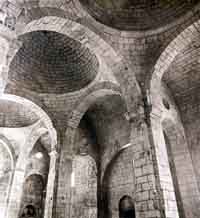
Interior of the church reveals its roman style.
|
Contemporary Fair. Currently the fair continues to be held, but only for a single day, on November 1 of every year, extending along A. Moro Street (ex Roma Street), Piave Street, Plebiscito Square, and other large streets in town, with the crossing streets. Merchandise sold includes utensils, agricultural implements, clothing, toys, and other wares. Livestock is traded on the road that leads from Valenzano to the "Lamie".
|

 Go Back


 English
 Italian